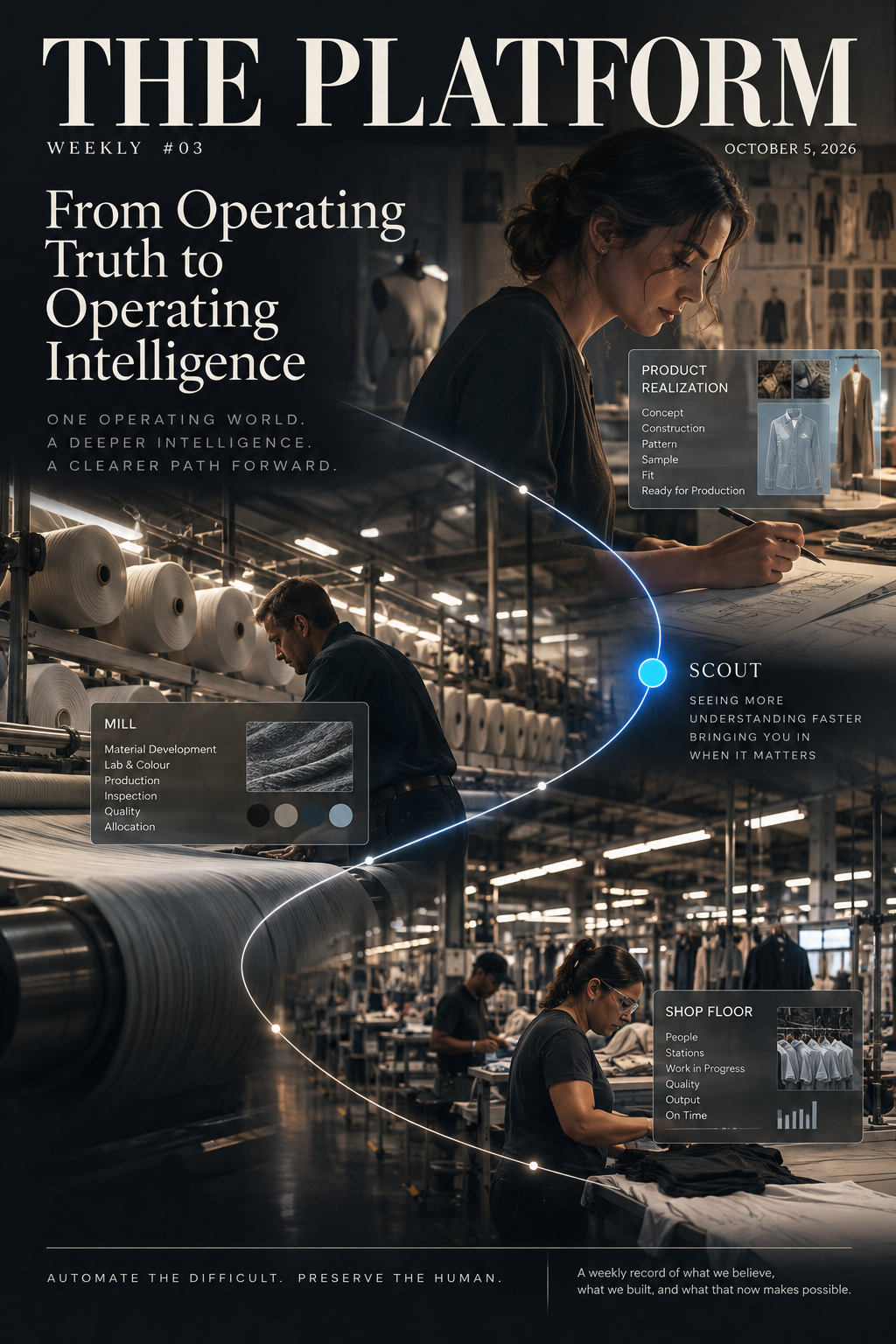
From Operating Truth to Operating Intelligence
What changed when the operating model reached the physical world and Scout had to become more than an explanation.
Last week, The Platform began learning that a connected manufacturing world was not enough. Before intelligence could safely act inside that world, it had to distinguish what was expected from what had actually happened, understand the evidence supporting a conclusion, preserve the consequences of human communication and remain clear about where machine authority ended and human judgment began. That changed our definition of readiness and began turning operating truth from a data concern into part of the architecture itself.
This week, the consequences of that foundation became much more visible. We moved onto the Shop Floor, then into the Mill, and began looking further upstream at the work required to turn creative intent into something physically manufacturable. At the same time, Scout began evolving beyond something that explains the operating world toward something capable of working inside it. Those developments initially appeared to be separate pieces of work, but they kept pointing back to the same idea: once the underlying operating model becomes coherent, the next capability does not have to begin from zero.
The speed was not the proof. The reuse was.
Shop Floor made that lesson tangible. A factory floor has its own language and urgency. People are working at stations, work is moving or waiting, time and capacity matter, quality can intervene while production is still underway, and materials move from physical inputs into work in progress and eventually into finished Products. A delay of fifteen minutes may be irrelevant in one context and the beginning of a missed customer commitment in another.
It would have been easy to treat all of that as another application to design from scratch. Instead, much of the operating grammar already existed. Products had identity, orders created demand, materials had physical existence, and people, teams, locations, quality events, commitments, evidence and readiness were already becoming parts of the same world. Shop Floor therefore became less about inventing another category of software and more about expressing what those existing truths look like while production is physically happening.
That distinction allowed the prototype to move quickly without requiring us to invent an entirely new conceptual model underneath it. In a matter of days, we could represent stations, people, work in progress, elapsed time, bottlenecks, quality conditions and the changing state of production. That does not make the prototype production-ready, because a real Shop Floor has to survive shifts, operator behaviour, machine failures, bad scans, missing data, peak periods and thousands of physical events. What the speed demonstrated was more fundamental: the foundation was beginning to compound, and the Mill would become the harder test.
A different operation should not require a different reality.
A textile mill is not a factory with different labels. The physical work is different, the terminology is different and many of the decisions are different. Material development can begin with yarn and construction, lab work introduces recipes, colour, chemistry and trials, and weaving or knitting creates physical fabric that is then altered again through dyeing, finishing and inspection. Each of those stages creates its own evidence, physical states and operating consequences.
That forced us to become more precise. A roll can physically exist while still being held from use, and a quality release does not automatically make that material suitable for every Product. A defect can belong to one roll while containment may need to apply to a much larger population. Available inventory cannot simply mean whatever quantity was produced, because the mill has to distinguish physical quantity, usable quantity, held quantity, committed quantity and the evidence supporting each of those states.
The surface therefore had to change because the work had changed. What did not need to change was the deeper logic. Material still has identity, still moves through transformations and still accumulates evidence around it. Quality still changes what may safely happen next, inventory still has a physical reality that must remain separate from permission to use it, and demand still creates pressure downstream.
That may be one of the strongest architectural lessons we have had so far. A mill, a factory, a Product team and a buyer should not be forced into the same interface because they are performing different work. But different perspectives should not require us to fragment the underlying truth every time the user changes. The Shop Floor can see production, the mill can see material transformation, Product can see readiness and Collections can see creative and commercial intent while all of them remain inside the same operating world.
The Mill also showed us where intelligence was still theatre.
As we pushed Scout further into the Mill experience, it became clear that some of what looked like intelligence was still explanation. Scout could describe what had happened, identify an apparent consequence and suggest a next action, but in several places the underlying capability had not actually performed the calculation, evidence evaluation or governed decision being described. That gap was uncomfortable, but it was one of the most useful discoveries of the week.
There is a world of difference between an AI saying that a material can safely be allocated and a system that has actually checked the material identity, usable quantity, quality state, current reservations, Product requirement, approved alternatives and authority required before reaching that conclusion. There is also a difference between saying that an exception affects a customer promise and having the real relationships that prove which rolls, Products, orders and commitments are involved. If Scout says something has been verified, something underneath has to verify it.
The same discipline applies to action. If Scout says an alternative is feasible, something has to calculate feasibility. If Scout says an action is safe, something has to establish the policy and authority that make it safe. Intelligence cannot become a convincing narration layered over incomplete operating logic, because the moment real manufacturing consequences follow, the distinction between explanation and execution becomes critical. That realization pushed Scout into a much more serious phase of its evolution.
Scout is becoming the operating intelligence of The Platform.
Our earliest Scout thinking focused heavily on presence. We wanted one persistent intelligence that could be reached wherever a person happened to be working, whether by clicking, typing, speaking or eventually simply saying "Hey Scout." It could remain visible without becoming another notification centre and could bring itself forward only when something genuinely deserved human attention. That idea still matters, but it is no longer the most important part.
Scout is increasingly becoming the intelligence that operates across the common model. The human should not need to know whether the work underneath requires a Production capability, a Quality capability, a Supplier capability, Trade intelligence, demand analysis or some other specialist function. The person should not have to understand our internal agent architecture before asking a question any more than they should have to understand our database architecture before asking where a material is. They should simply talk to Scout.
Behind that single presence, bounded capabilities can do the specialist work. Scout can maintain the human conversation and operating context, determine what needs to be investigated, gather the relevant evidence, invoke the appropriate capability and return with an interpretation, a prepared action or a request for human judgment. The intelligence can become more specialized underneath while becoming simpler for the human above.
That changes the meaning of an agent architecture. We do not need a zoo of named agents wandering around the interface and handing the user from one personality to another. We need governed capabilities with clear missions, evidence requirements, authority boundaries and acceptance criteria, all operating over the same Platform truth. Their reasoning may differ, but their truth cannot.
Operating intelligence needs somewhere real to stand.
Shop Floor and Mill are important to Scout for exactly that reason. Intelligence becomes meaningful only when it has a world precise enough to reason about. A system cannot understand production risk if there is no real production state, and it cannot understand material suitability if quality, lots, transformations and requirements are merely labels on screens. It cannot recognize a missed supplier commitment if commitments disappear inside email or messaging history.
The richer the operating model becomes, the more useful Scout can become. But the relationship works both ways, because the richer Scout becomes, the more demanding it is about the operating model underneath. Every confident explanation raises the question of where the evidence came from, every proposed action raises the question of who has authority, and every suggested alternative raises the question of whether the system truly understands the consequences.
That is why the principle from last week becomes even more important now: The model reasons. The Platform controls. Model confidence can never create manufacturing authority. A highly confident model should not release questionable material, approve a customer exception, substitute a component, change a machine parameter or alter a customer commitment simply because the reasoning sounds convincing.
Some routine work may eventually happen quietly under explicit delegated policy, and requiring a human approval for every mechanical action would simply turn governance into another form of bureaucracy. The goal is not to insert humans everywhere. The goal is to make the boundary between machine responsibility and human responsibility intelligent.
The system should carry the noise until the human genuinely matters.
That idea is beginning to influence the visual language as well. Red already has meaning inside an operating environment, amber has meaning and green has meaning. We needed something different for the moment when the system is not saying that something has failed or passed, but that human judgment is genuinely required. Blue began taking on that role.
The Blue Dot therefore represents something more consequential than a design accent. It means that The Platform has handled what it reasonably can and has reached a point where creativity, experience, negotiation, relationships, accountability or judgment now matter. It is not another alert colour competing for attention. It is the point at which human attention becomes valuable.
That distinction becomes more important the deeper we go with Scout. Manufacturing software has traditionally demanded attention constantly because people carry the burden of discovering whether something matters. They check dashboards, queues, messages and spreadsheets, chase suppliers and compare versions because the systems around them do not understand enough of the context to know when intervention is actually necessary.
The Platform should gradually reverse that relationship. The operating model should watch continuously, Scout should investigate where appropriate and routine coordination should increasingly disappear into the background. The person should not become less important as a result. The person should become more important precisely because they are being brought forward for the things software cannot responsibly replace.
The Blue Dot begins to express that philosophy visually. It marks the moment where machine responsibility meets human responsibility, and where the system effectively says: I have carried this as far as I safely can. Now you matter.
Voice starts changing the choreography of work.
We saw a small but revealing example while working through Product development. A designer taking physical measurements should not necessarily have to stop, put down the tape, find the correct field, type a number, save it and then move to the next measurement. The interface can adapt to the physical work instead. The person can continue measuring and speak naturally while The Platform preserves the structured result.
The interesting part is not speech-to-text. It is what happens when natural intent begins replacing unnecessary interaction choreography. A person should increasingly be able to ask why a Product is not ready, what they are waiting for, whether a material can be used, which orders are affected or what happens if production moves, without first knowing where inside the application those answers happen to live.
Scout should assemble that context and bring back the useful visual object when one is needed. Evidence, documents, comparisons, calculations, alternative paths and prepared actions can appear temporarily around the conversation and then disappear when the decision is complete. The interface becomes less about navigating software and more about expressing intent while the operating structure remains disciplined underneath.
Voice therefore does not eliminate structure. It hides unnecessary choreography. The simpler the experience becomes above the system, the more rigorous the system has to become below it.
The operating model is also moving further upstream.
Shop Floor and Mill pushed us deeper into manufacturing execution, but the work raised the opposite question as well. What happens before something is ready to enter either environment? There is a substantial body of work between creative intent and a Product that can actually be manufactured, including construction, measurements, patterns, grading, material behaviour, marker planning, sampling and fit.
That is the idea behind Product Realization. The name matters less than the boundary it removes. Today, those activities frequently exist across another collection of specialist systems and handoffs, with design in one environment, specifications in another, pattern work somewhere else and sampling inside a chain of files, meetings and messages.
The Product is therefore represented again and again as it moves from creative intent toward physical execution. Research into systems such as Tukatech is useful because it reveals how deep that physical knowledge actually becomes. Pattern making, grading, marker planning, three-dimensional garment construction and material behaviour are not secondary details around Product development. They are part of what turns an idea into something a factory can reliably make.
Our opportunity is not simply to reproduce another specialist application. It is to ask whether those capabilities can eventually contribute to the same Product truth. An inspiration image can become structured Product intent, Product intent can become construction, construction can become measurements and patterns, those can become samples and fit decisions, and approved Product truth can flow naturally into sourcing and the production configuration actually used to make it.
The Product should not be recreated every time it crosses another organizational or software boundary. It should become progressively more complete and more physically real. Seen that way, Product Realization is another expression of the same operating thesis rather than another application sitting beside it.
The commercial model started catching up with the architecture.
This week also included an important founder conversation because the operating thesis was challenged from a completely different direction. We were no longer asking only what we could build. We were asking how to explain it, how somebody might buy it, how a company could begin using it without destroying everything it already had, and how an investor could understand something that deliberately refuses to fit neatly inside PLM, ERP, Shop Floor or another familiar enterprise category.
The discussion led to an important distinction between architecture and adoption. The operating model can remain unified while the commercial entry point is modular. A customer may initially need Product development, another may have a serious execution problem and another may already have an ERP they have no intention of replacing.
We should be able to enter where the pain exists, integrate with what still serves a purpose and allow more of the operating world to move into The Platform as value is proven. That does not mean turning The Platform into a bundle of disconnected modules. It means allowing a customer to adopt one operating model progressively rather than forcing a transformation programme before the first useful outcome has been delivered.
This gives us a more credible path between ambition and adoption. Integration can remain a migration strategy while the long-term architecture stays coherent. The customer does not have to choose between a risky rip-and-replace project and another isolated point solution.
The team started moving with the same rhythm.
Perhaps the most encouraging development this week did not happen in the software at all. Our founder conversation made the different instincts around the table unusually visible. There is a vision that naturally keeps pushing the boundary outward, an engineering discipline continually testing whether that vision can actually be built, a commercial perspective asking what problem someone will pay to solve and how the value should be explained, and the work of turning those perspectives into a coherent narrative and an actionable path forward.
Those instincts could easily pull against one another. Instead, they started becoming complementary. The conversation moved naturally from the Product itself into the story required to explain it, the investment case required to fund it, the resources required to accelerate it, the route from prototype into MVP and pilots, and the organizational questions that start appearing when an experiment becomes something people intend to commercialize.
That synchronization matters because large ideas can remain comfortably abstract while everyone is looking at them from the same direction. They become much more credible when product, engineering and commercialization challenge the thesis independently and still find reasons to move toward the same destination. The meeting felt less like a collection of people contributing opinions and more like a team beginning to understand how its different strengths fit together.
There is an interesting parallel with The Platform itself. Different roles do not need the same perspective, and in fact they probably should not have it. They need a shared understanding of what is true and enough trust in one another to work from different viewpoints without fragmenting the whole.
What the week really changed.
Weekly #01 was about connection. Manufacturing began to exist as one operating reality rather than a collection of software categories. Weekly #02 was about trust, because a connected world was not enough without evidence, authority, continuity and a clearer understanding of what the machine could safely do.
This week was about what begins to happen when those ideas compound. Shop Floor showed that the foundation could extend into physical execution without creating another operating universe. Mill showed that the same model could stretch into a very different kind of manufacturing while preserving the distinctions that make that work real. Product Realization began exposing the next upstream boundary, where creative intent turns into something physically manufacturable.
Scout changed alongside them. It began as the idea of a persistent intelligence layered across The Platform and is increasingly becoming the operating intelligence through which bounded capabilities may be coordinated. It is not a chatbot, not a collection of agents the user has to manage and not an omnipotent machine pretending to know more than the operating truth underneath it can support.
At the same time, the founder conversation brought another kind of reality into the room. We began asking how this becomes understandable, adoptable, investable and eventually useful inside a real company. That transition matters because the world does not need another fascinating prototype. It needs something capable of surviving the distance between an ambitious idea and the complicated physical reality of manufacturing.
Three weeks ago, The Platform was still largely a thesis about how manufacturing ought to work. Then it began acquiring an operating world, and that world began acquiring truth. This week, intelligence began finding its place inside that world while the people building it began moving around the same centre.
The architecture is getting bigger while the experience should become quieter. The machine should carry more of the difficult work, and the human should matter more precisely because of it. That is increasingly what Automate the Difficult. Preserve the Human. means in practice.
Automate the Difficult. Preserve the Human.
Reference points for this issue
- CGS BlueCherry Shop Floor Control, as a reference point for production-floor execution, people, time and work-in-progress management.
- Tukatech, as a reference point for the depth of Product Realization across pattern, grading, marker and three-dimensional garment work.
- Datacolor, for textile colour formulation and process-dependent colour correction.
- SETEX, for textile production, batch and machine-connected operating information.
- Uster, for fabric inspection, defect mapping and usable-material decisions.
- Current work in persistent agents, natural voice interaction and governed capability orchestration informing the continued evolution of Scout.