The More We Understand, the Bigger the Picture Becomes
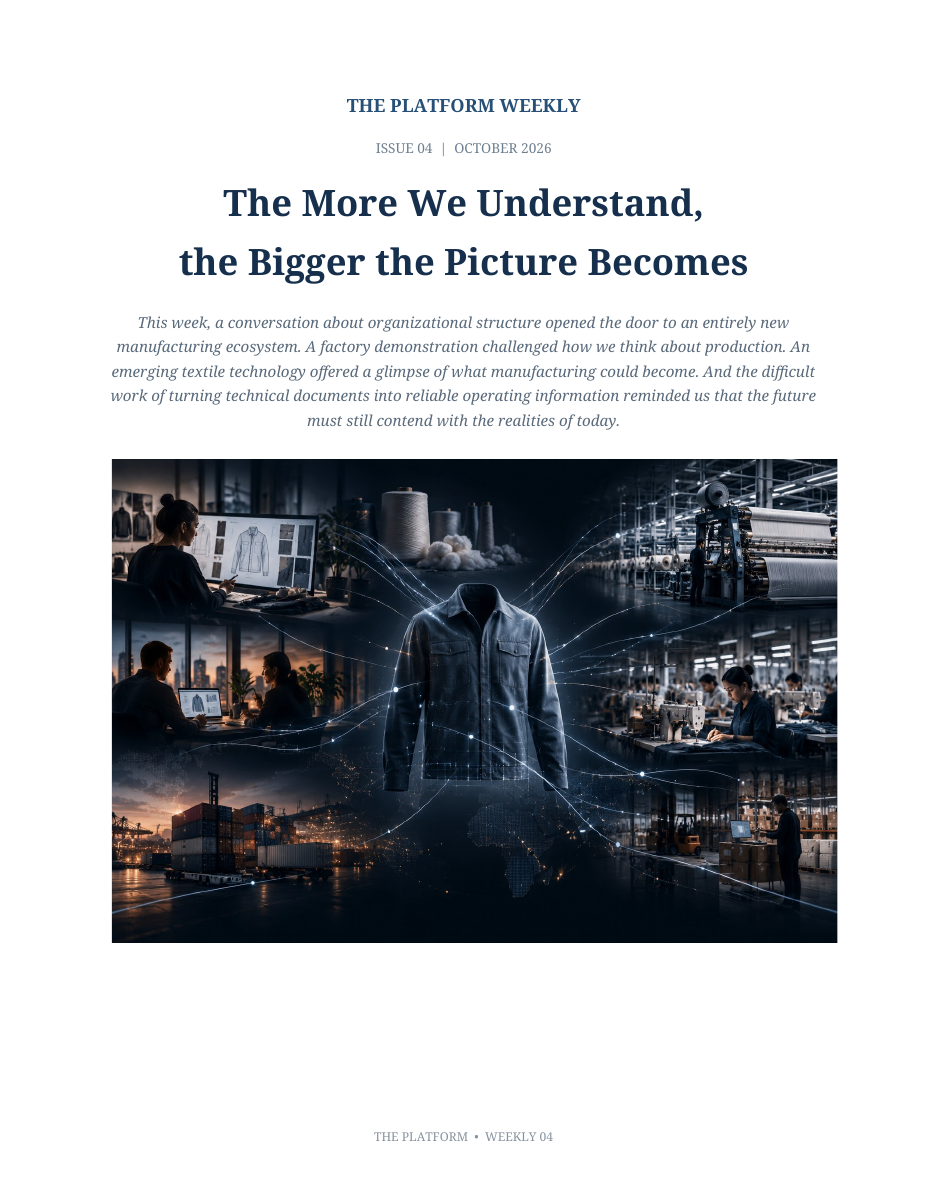
This week, a conversation about organizational structure opened the door to an entirely new manufacturing ecosystem. A factory demonstration challenged how we think about production. An emerging textile technology offered a glimpse of what manufacturing could become. And the difficult work of turning technical documents into reliable operating information reminded us that the future must still contend with the realities of today.
The architecture keeps revealing more than we expected.
One of the more interesting developments this week began with a relatively ordinary question. As we continued developing The Platform, we needed to distinguish between different types of organizations. A brand, a garment factory and a textile mill are all businesses, but they operate differently, have different responsibilities and participate in different parts of the manufacturing process. At first, this appeared to be another exercise in defining organizational attributes and relationships. The more we examined it, however, the more we realized that the question was pointing toward something considerably larger than the immediate development requirement.
Consider what happens when a brand places an order with a factory. From the brand's perspective, it is a purchase order. From the factory's perspective, it is a sales order. The factory may then need fabric, creating a purchase order to a textile mill, which in turn sees that transaction as a sales order. Each business has its own inventory, production responsibilities, financial obligations and operational decisions. Yet all three are participating in a connected chain of activity around the same product. Traditional software generally represents these relationships through separate records maintained by separate companies, with documents and messages passing between them to keep everyone reasonably synchronized.
Our discussion raised a different possibility. What if the architecture understood these organizations, their roles and the relationships between them from the beginning? Each business would still maintain its own operational truth, commercial records, permissions and authority. A brand's purchase order would not simply become a shared document that everyone could modify. But the underlying relationship could be represented coherently, allowing the system to understand how one organization's requirements become another organization's commitments, and how those commitments create further requirements upstream.
That distinction matters because our original ambition has never been to connect a collection of independent applications. We are building a new way for an organization to operate, with product information, commercial activity, materials, production and intelligence working from a common foundation. Once that foundation can accommodate multiple organizations without compromising their independence, something interesting begins to happen. The same architecture that helps a business understand itself can begin to support meaningful relationships with other businesses.
And that opens another door. If the system understands what a factory produces, which materials it uses, what capabilities it has and how it participates in manufacturing, those relationships could eventually support discovery and commercial opportunity. A brand looking for production capacity might identify factories with relevant capabilities. A factory sourcing a specialized textile might discover suitable mills. Over time, verified capabilities, availability,
performance and commercial requirements could help organizations find one another and establish new relationships. A marketplace becomes a possibility, but not because we decided to build another marketplace. It emerges from the operating knowledge and relationships already being established.
We have not built that ecosystem, and important questions remain around commercial privacy, permissions, verification and how much information organizations would be willing to share. Nevertheless, the discovery was significant. A relatively small architectural conversation revealed how the boundaries of the operating model could extend beyond the individual business without sacrificing the simplicity we are trying to create inside it. It was a useful reminder that sometimes the most consequential ideas emerge not from adding another feature, but from understanding the structure of the problem more completely.
The factory has its own truth.
While those discussions were expanding our understanding of the broader ecosystem, our work with Miguel brought us closer to the physical realities of manufacturing. The Shop Floor demonstration and subsequent conversations provided an opportunity to examine the emerging operating model against the rules and practices of an actual factory. This is a different kind of learning from developing screens, defining workflows or studying existing manufacturing systems. It requires us to understand what people do, how their work is measured, where responsibility sits and what happens when production does not proceed exactly as planned.
The details were revealing. At Simatex, production is organized around bundles, and operators are credited for completed bundles rather than partially completed work. Bundles cannot be divided between operators performing the same operation. Piecework rates are established by engineering through time-and-motion studies, while rejected or damaged pieces remain part of the operator's recorded production and must subsequently be repaired. Missing tickets are reconciled by engineering, and the information required for payroll is still transferred manually from individual production reports. These practices reflect specific decisions about production control, compensation and accountability, rather than arbitrary limitations of an existing application.
What became clear is that a production event cannot be understood simply as a quantity completed against an operation. It may carry consequences for employee compensation, quality, work in progress, engineering reconciliation and the readiness of the next production stage. If a bundle is missing, the system needs to distinguish between missing information and missing physical work. If a piece requires repair, it must understand the relationship between production credit and quality responsibility. If engineering changes an operation rate, that
decision needs an appropriate history and authority. These are precisely the kinds of relationships that intelligent manufacturing must understand if it is to do more than display production activity.
There is also a larger lesson here about the role of intelligence. The objective should not be to replace the factory's operational judgment with a generic automated interpretation. It should be to reduce the effort required to maintain accurate information, recognize exceptions, reconcile discrepancies and prepare decisions while preserving the authority of the people responsible for production. Miguel's input gives us a much more grounded basis for evaluating Shop Floor, but it does not mean that every practice has already been implemented or validated. The next responsibility is to translate what we learned into clear operating rules and test them against actual workflows.
The experience reinforced something that has been developing throughout this initiative. Manufacturing intelligence cannot exist independently of manufacturing reality. It has to understand the work well enough to recognize when the digital representation and the physical world disagree, and it must know when that disagreement requires human attention.
Looking at manufacturing from the other direction.
Our exploration of unspun, including the discussion around Michael and the possibility of future collaboration, introduced another perspective. Where Miguel's factory helped us understand the operational realities of established apparel production, unspun's technology points toward a different way of making textiles and garments. Its work around advanced weaving and automated production challenges some of the traditional assumptions about how fabric, garment construction and manufacturing capacity are organized. That makes it relevant to our thinking, not simply as an interesting technology company, but as an example of how the physical manufacturing process itself may evolve.
Much of the software used throughout apparel manufacturing assumes a relatively familiar sequence of activities. Products are designed, materials are sourced, fabric is produced, garments are cut and sewn, and finished goods move through distribution. New manufacturing technologies can change that sequence, eliminate certain steps or introduce entirely different production requirements. If we are building an operating model intended to serve manufacturing over the long term, we need to understand how it accommodates those changes without becoming dependent on one particular production method.
This is where the relationship between Product Realization, Mill and Shop Floor becomes especially interesting. The creative intention behind a product must eventually become something that can be manufactured, but the path from design to production may differ
substantially depending on the materials, machinery and processes involved. An intelligent operating environment should be capable of understanding those differences while preserving the relationships between product requirements, manufacturing capabilities, costs, quality and execution. The purpose is not to reproduce every specialized engineering tool inside The Platform immediately. It is to establish an operating foundation that can support changing production methods as the underlying capabilities mature.
We are still exploring what a practical relationship with unspun might look like, and it would be premature to describe the discussion as an established partnership or technical integration. What matters for this week's thinking is the perspective it adds. We are learning from the factories operating today while examining technologies that could change how factories operate tomorrow. Both are necessary if we want the architecture to remain relevant beyond the first generation of products we build.
A technical document is not yet an operating reality.
Back inside The Platform, the work of importing technical specifications provided a more immediate and sometimes frustrating encounter with complexity. We have been developing the ability to take an existing apparel tech pack and transform its contents into structured Product information. The ambition is straightforward to describe: a business should not have to manually reconstruct the same product information simply because it is moving from a document into an operating system. Measurements, construction details, bills of materials, images, colourways and other specifications should be interpreted and carried into the appropriate product structures with as little unnecessary human effort as possible.
The difficult part is preserving the meaning and relationships contained in those documents. A tech pack is not simply a collection of text and images. It is a working description of a product, often assembled from tables, drawings, annotations, inconsistent terminology and information distributed across multiple pages. A bill of materials may reference components already known to the business. A colourway may change the material requirements without changing the underlying product. A measurement table may depend on a particular size scale and grading rules. Interpreting these elements individually is not enough if the relationships between them are lost during the transformation.
This week's testing with a new customer document exposed several weaknesses in that process. We encountered stalled creation workflows, incomplete component and colourway handling, and differences between what appeared to have been interpreted and what was ultimately available in the product record. The work also brought us back to capabilities previously demonstrated in Kompono, where detailed imports, including images and bills of materials, had already been exercised under real customer conditions. Those earlier results remain valuable
evidence and a source of implementation knowledge, even as we move toward a different architectural foundation.
The lesson is not that intelligent document interpretation is beyond our reach. It is that successful interpretation is only one part of a reliable operating workflow. The system must also resolve relationships, preserve evidence, identify uncertainty, commit the correct information and verify that the resulting Product reflects what the source actually specified. A convincing preview cannot substitute for a completed, accurate record. When something fails, the user needs to understand what happened and what remains unresolved rather than being left with an apparently successful process that never finished.
This has direct implications for Scout. We have spent considerable time exploring intelligence that can understand the business, recognize conditions, prepare decisions and coordinate work across the operating model. The importer reminds us that this intelligence must also be accountable for outcomes. Understanding what should happen is not the same as confirming that it happened. That distinction becomes more important as we move from assistance toward governed actions that affect real products, orders, materials and production.
The experience must be as coherent as the architecture.
Another useful discussion emerged from Will's demonstration of the commercial and supply workflows. We examined the relationship between Sales Orders, Supply Requirements, Procurement and Purchase Orders, particularly the sequence through which a business determines what it needs before deciding what to buy. These capabilities are already represented within our development work, but their relationship was not always clear from the way the experience was presented. The conversation helped distinguish between identifying requirements, evaluating available inventory, resolving shortages and executing the purchasing decisions that follow.
This may sound like a relatively modest interface concern, but it points to an important principle. A clean underlying architecture does not automatically create a simple experience for the people using it. If users have to navigate several disconnected-looking areas to understand a single commercial process, we risk recreating the fragmentation we set out to eliminate, even if the information underneath is technically connected. The operating model has to make relationships understandable in the natural flow of work, not merely store them correctly.
The same issue is becoming visible as we expand into Collections, Shop Floor and Mill. Each area has its own operational context, but the user should not feel that they are moving between unrelated products. A product moving from development into sourcing, production and delivery remains the same product, with its history and relationships intact. The interface needs
to reflect that continuity while giving each person the tools and information appropriate to their responsibilities. Simplicity is not the absence of complexity. It is the result of organizing complexity so that people can act without constantly reconstructing the whole picture.
Turning a broad vision into a credible beginning.
The conversations with Kevin, Chris and Will also continued to sharpen how we explain and commercialize what we are building. There is a natural tension between describing the full ambition of an intelligent manufacturing operating environment and identifying the first practical reason a business would adopt it. We need both. The larger architecture provides the direction and prevents us from building another collection of isolated applications, while a focused commercial entry point gives customers something they can evaluate, understand and begin using.
Our emerging MVP direction brings together Product and technical specification creation with sales, purchasing and inventory. This is not intended to represent the full scope of The Platform in its first release. Rather, it creates a practical starting point around information and workflows that are fundamental to running a manufacturing business. A product needs to be defined, sold, sourced and fulfilled. Connecting those activities through one foundation creates immediate operational value while establishing relationships that can support Shop Floor, Mill, Product Realization and broader ecosystem participation as the system develops.
The funding discussions have become more concrete as well. A credible development plan requires more than an ambitious roadmap and a headline investment figure. It requires clarity about engineering resources, individual responsibilities, development activities, operating costs and the evidence we expect to produce with the capital. The work of breaking down those requirements may be less visible than a product demonstration, but it is an essential part of turning the initiative into a sustainable business.
What has become clearer through these conversations is that our positioning should remain grounded in three connected ideas. Simplicity is the promise: everything in one place, without the burden of navigating disconnected systems and reconciling competing versions of information. Architecture is the differentiator: a common foundation in which products, organizations, materials, orders and operational relationships belong together rather than being stitched together afterward. Intelligence is the multiplier: the ability to understand those relationships, identify what matters and help people make better decisions with less unnecessary effort.
The challenge is to communicate those ideas without reducing them to another familiar category of manufacturing software. We are not rejecting the experience accumulated in
existing systems, nor are we suggesting that every established process should be discarded. We are questioning whether the underlying structure through which businesses operate can be fundamentally improved. That is a more ambitious proposition, but it must ultimately be demonstrated through practical results rather than persuasive language alone.
What the week really changed.
Looking across the week, the most interesting development was not a single feature, meeting or technical breakthrough. It was the way different conversations began reinforcing one another. A question about organizational roles revealed the possibility of a connected commercial ecosystem. A factory demonstration showed us the operational rules that must exist beneath any credible Shop Floor intelligence. An exploration of new textile production technology challenged us to think beyond established manufacturing sequences. And a difficult importer test reminded us that none of these possibilities matter unless the underlying information can be trusted.
There is a pattern emerging from these experiences. Every time we look more closely at a part of manufacturing, we discover relationships that extend beyond the immediate problem. A production bundle connects operations, quality, engineering and compensation. A technical specification connects design intent to materials, manufacturing instructions and commercial commitments. An order connects independent businesses through a chain of requirements and responsibilities. A new production technology changes not only how something is made, but potentially how it must be designed, planned and coordinated. The individual activities may appear separate, but the operating reality underneath them is deeply connected.
This is why I remain convinced that the opportunity is larger than building better tools for individual manufacturing functions. The difficult part of running a business is often not performing an individual task. It is maintaining an accurate understanding of how thousands of tasks, decisions, commitments and exceptions affect one another. People spend an extraordinary amount of time finding information, checking whether it is current, resolving contradictions and communicating changes that should already be understandable within the system. Those burdens have become so familiar that we often treat them as an unavoidable part of work.
We are beginning to see how a different foundation might change that. Not by removing the knowledge and judgment of the people who understand manufacturing, but by giving that knowledge a more coherent operating environment. Not by automating decisions simply because the technology allows it, but by distinguishing between the difficult work a system can reliably perform and the decisions that still require human responsibility. And not by adding
another marketplace, another dashboard or another AI assistant, but by allowing useful capabilities to emerge from a connected understanding of how the business actually operates.
There is still a substantial distance between this emerging model and a fully functioning intelligent manufacturing environment. Some capabilities are working, others require significant refinement, and several of the opportunities we uncovered this week remain architectural possibilities rather than implemented products. But the direction is becoming clearer because it is being challenged by actual manufacturing practices, real documents, evolving technologies and the practical demands of commercialization. Each encounter gives us a more accurate understanding of what the system must eventually support.
Perhaps that is the most important observation from the week. We are not making the vision larger by continuously adding new ambitions. We are discovering how much of manufacturing is already connected beneath the fragmented systems through which people manage it. The more carefully we understand those relationships, the more possibilities become visible, and the more responsibility we have to build the foundation correctly.
Automate the Difficult. Preserve the Human.