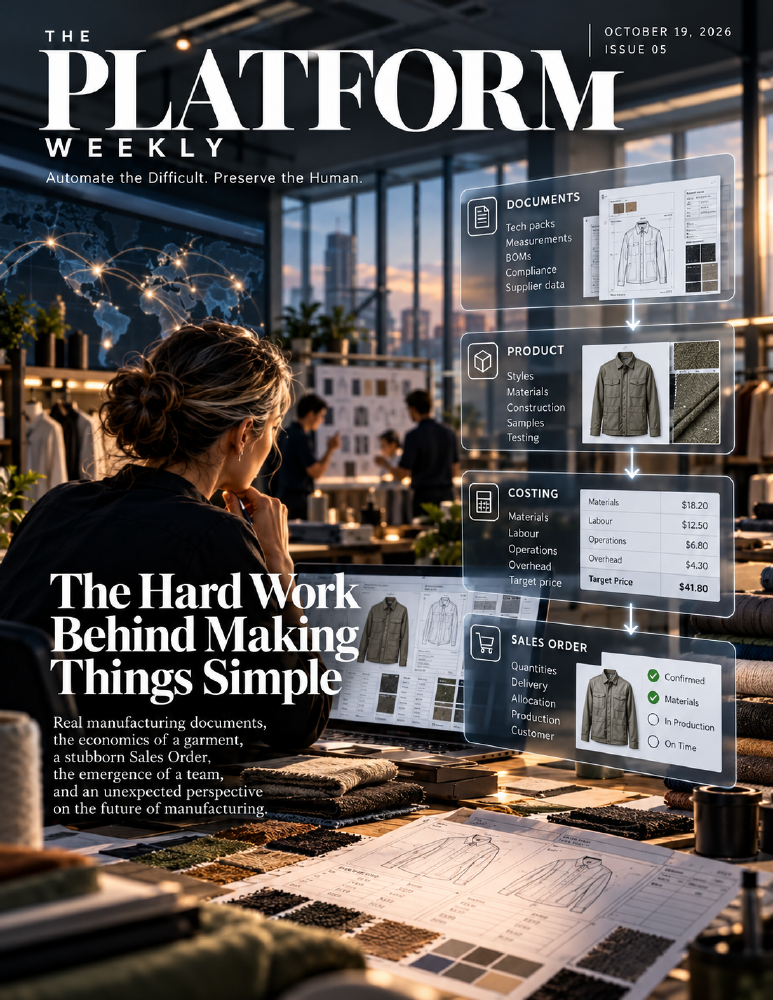
The Hard Work Behind Making Things Simple
The reality is proving more interesting than the demonstration.
There is a point in developing any ambitious technology when the demonstrations have to give way to reality. The carefully prepared examples disappear, actual customer information arrives, and the software is expected to behave as though it understands the business it was designed to serve. We have been spending considerably more time in that environment recently, and it has been both encouraging and occasionally exasperating.
Our ambition remains to develop one Intelligent Manufacturing operating model connecting product development, costing, materials, purchasing, production and the decisions that move work through a business. What is changing is our understanding of how much work is required to make that experience feel natural. This week we continued testing the import and translation of real technical documents, confronted the difficulties of turning customer information into reliable orders, and examined how costing fits into the same operating reality. Alongside that work, our research into Shein's Xcelerator raised questions about the future of manufacturing networks, while the team and commercial plan began coming into closer alignment with the product itself.
The common lesson was not that manufacturing needs more elaborate screens or more intelligence demonstrations. It was that a system should carry more of the burden of interpreting information and connecting decisions, leaving experienced people to concentrate on the work they actually understand. The difficulty of doing that well has become the most interesting part of our development.
The long journey to a simple comparison.
One of our more revealing development exercises began with an ambitious but practical objective: take the technical documents a customer already uses and translate their contents into a functioning product within The Platform. We did not want customers recreating the same information manually or preparing special files to accommodate our software. The attraction of intelligent interpretation is that it should work with the documents manufacturers already exchange every day.
Real technical packages quickly exposed the limitations of a controlled demonstration. Apparel information is created for people who know the industry, and it arrives in the customer's own layouts, tables, annotations and conventions. Our early testing focused on interpreting that information and translating it into the structures used by the operating model. Component matching, colourways, missing information and the persistence of corrections all required attention. At times the extracted preview looked more complete than the actual saved product record, a particularly useful reminder that reading a document and establishing a usable operating record are not the same achievement.
We kept testing against the original documents rather than treating each visible field as an independent success. Information needed to be interpreted correctly, associated with the right product relationships, preserved when corrected and recoverable when someone returned to the product. Just as importantly, we challenged the experience of reviewing uncertain information. Some exceptions genuinely require manufacturing judgment, but others exist because the system has failed to understand something already present in the source. Asking a person to resolve every one of those uncertainties defeats much of the purpose of intelligent import.
The work took a more interesting turn when we introduced successive documents from the same garment's development. We began with the original technical information, followed it with the Fit sample and then brought in Pre-Production. Having spent so much time getting the underlying information into a reliable form, we could finally begin examining how the product had evolved rather than treating each document as an unrelated import. The questions shifted toward the clarity of the comparisons, the recognition of changes between stages and whether the product's status reflected the evidence already received without inventing formal approvals.
Some of the results were technically informative but harder to read than they needed to be. We questioned the way differences were presented, the usefulness of source references and whether the reviewer could quickly understand what had changed. This was an important part of the testing, because a system can hold the right information and still fail to make it useful. The destination was a familiar Fit-to-Pre-Production comparison, but reaching it required the import, translation, preservation and interpretation of a continuing product history.
There is something fitting about that outcome. To someone working in apparel development, comparing successive samples is ordinary business. The sophisticated part should be everything the operating model does underneath to make that ordinary task easier. The exercise gave us a more demanding definition of progress than a successful PDF extraction: a product that can be understood and worked with as it moves through development.
Costing brings the economics into the same picture.
Costing has been another important area of our development thinking, and it is becoming increasingly difficult to separate from Product Realization. The technical information we have been working to interpret has commercial consequences. Materials, consumption, construction, manufacturing operations, labour assumptions and supplier conditions all contribute to the economics of a garment. In most manufacturing businesses, experienced people bring those elements together using information collected across departments, often with spreadsheets holding a substantial portion of the working knowledge.
The opportunity is not to replace that experience with a formula. It is to connect the assumptions behind a costing to the product and manufacturing information from which they originate. A costing represents an understanding at a particular point in time, and that understanding may evolve as development progresses, suppliers are selected and order quantities become known. Preserving the reasons behind a number is at least as important as preserving the number itself.
This also forces us to distinguish estimates from commitments and actual manufacturing costs. They are related, but they are not interchangeable descriptions of commercial reality. If a revised costing simply overwrites an earlier one, the business may lose the evidence needed to explain why expectations changed. A connected operating model should eventually make those relationships easier to follow and help identify which assumptions deserve another look when the underlying product or manufacturing conditions change.
We are not claiming that the complete costing intelligence has already been built. The development challenge is to establish a reliable initial costing process while ensuring the architecture can connect technical, sourcing and manufacturing decisions over time. The more closely we examine that requirement, the clearer it becomes that costing is not a separate destination in the software. It is part of the economic history of the product.
The Sales Order that became an obstacle course.
The Sales Order work offered a different kind of lesson. We had been developing the import of customer order information into a commercial record, including product-specific size sequences, quantities, prices, original documents and the ability to review and preserve corrections. In principle, the task was straightforward: interpret the customer's order, review genuine exceptions and establish a trustworthy commitment that can support purchasing and manufacturing.
During testing, the experience became unnecessarily complicated. We were confronted with unresolved fields, intermediate states and confirmation steps that appeared to reflect the system's internal structure more than the needs of the person processing the order. The question became painfully direct: why were we jumping through so many hoops to confirm an ordinary Sales Order? The fact that the software could expose an uncertainty did not necessarily mean the user should have to resolve it manually, especially when relevant information was already available.
Persistence was just as important as interpretation. Corrections had to remain intact, the original customer document needed to be available for reference, and an order should be recoverable after an interrupted session. These details can seem unremarkable compared with intelligent document recognition, but they determine whether the resulting record is trustworthy. A convincing preview is not a substitute for a saved order that someone can reopen and use.
The larger commercial process remains important. An accepted order establishes demand that must eventually connect to material requirements, available inventory, procurement and production commitments. But there is no advantage in designing an elegant chain of downstream relationships if the first step is unreliable or unnecessarily difficult. The testing brought us back to a simple expectation: the operating model should understand enough to make confirming an order easier, not require an administrator to understand the architecture in order to complete the task.
Scout must understand the work, not merely describe it.
These experiences are giving us a more practical definition of Scout, the single intelligent operating presence we envision across The Platform. We are not trying to create a collection of assistants that each understand a narrow department and require people to explain the same business context repeatedly. Scout should draw on governed capabilities while maintaining an understanding of the relationships between products, materials, orders, processes and decisions.
In technical-document importing, that means recognizing information in the context of the product and knowing which uncertainties genuinely require review. In costing, it means understanding the assumptions behind the calculation rather than simply displaying the result. In order processing, it means distinguishing a commercial exception from an administrative problem the system should have resolved itself. These are different capabilities, but they belong within one coherent operating environment.
The distinction between understanding and authority is equally important. Receiving a Fit sample may be evidence that a product has advanced, but it does not necessarily establish formal approval. Identifying a possible cost consequence is not the same as knowing its exact value. Preparing a purchasing action is not the same as being authorized to make the commitment. Scout's usefulness will depend on evidence, context and clearly governed boundaries between interpretation, recommendation, approval and action.
Manufacturing already contains a great deal of intelligence in its people. The purpose of the operating model is to reduce the administrative work surrounding that intelligence, make the necessary information easier to understand and preserve human authority where it matters. Our recent testing is helping define that ambition in concrete manufacturing terms rather than as another technology demonstration.
A larger question from Shein.
Alongside the practical development work, we examined Shein's Xcelerator initiative, which offers supply-chain and logistics capabilities to other brands. The public information does not reveal the proprietary application or the full operating architecture, and we should not pretend otherwise. What interested us was the commercial direction: manufacturing coordination itself can become a service extended beyond the business that originally developed it.
That connects to our earlier thinking about relationships between brands, factories and textile mills. A brand's purchase order becomes a factory's sales order. A factory's order for fabric becomes a mill's sales order. Each organization retains its own responsibilities, records and commercial interests, but the activities are related. Conventional software tends to treat those organizations as separate worlds even though the products and materials move continuously between them.
Our work around material sourcing suggests another point of connection. A brand selecting fabric, requesting sample yardage and directing it to a factory begins establishing a relationship among several businesses before a production order necessarily exists. That relationship may later involve technical evaluation, costing, sourcing and manufacturing commitments. Understanding how it develops could eventually support a much richer manufacturing network than a directory of suppliers or a simple transaction marketplace.
Any such environment must respect commercial boundaries. A factory's internal cost is not automatically visible to its customer; a mill may choose what capacity or pricing information to share; and a brand's development records do not become common property simply because several suppliers participate. Trust, permissions and independent authority are part of the architecture, not optional additions.
Xcelerator is not a reason to change the MVP into a marketplace. It is a useful external signal that coordinated manufacturing capabilities may have commercial value across organizations. The foundation for that possibility begins with the same unglamorous requirements we are testing today: reliable product information, trustworthy orders, meaningful material relationships and governed decisions.
The people are becoming part of the operating model.
The team has also been developing alongside the product, and this deserves more attention than it would receive in a conventional software progress report. Building an Intelligent Manufacturing business requires more than engineering capacity. Manufacturing knowledge, product judgment, commercial experience, industry relationships and capital formation all have to inform one another, particularly while the product and its market proposition are still taking shape.
Our recent testing has shown why those perspectives matter. A technically convincing import can fail the expectations of an experienced product developer. A logically structured Sales Order workflow can become an obstacle course for someone who processes orders every day. And a compelling vision for a connected manufacturing ecosystem can be difficult to finance if the first commercial offering and the resources required to deliver it are not sufficiently clear. None of these problems can be solved effectively by one discipline working in isolation.
The product, process and commercialization discussions are becoming more closely aligned because there is now more tangible work to examine. Real documents, working screens, unresolved issues and increasingly specific workflows give the team a common basis for debate. The technical work can be challenged by manufacturing experience, while the commercial proposition can be tested against what is actually demonstrable and what still needs development.
Chris and Will have been advancing the investor narrative and working through relevant relationships, while emphasizing the need for a credible product demonstration, financial model and clear use of funds. Their perspective also brings realism to the timing. Investor interest, diligence, commercial validation, terms and the arrival of funds are distinct stages. We cannot plan development as though an introduction automatically translates into available capital.
That creates a useful discipline. We need a product that demonstrates recognizable customer value, a team capable of delivering the next stage and a commercial plan that reflects realistic milestones and resource requirements. The people involved are not simply being assembled to execute a finished specification. Their experience is helping determine what the operating model should become and how it can reach the market.
Two tracks, one direction.
We have deliberately maintained two parallel tracks. One is the practical MVP, where the immediate work is to develop reliable workflows, test them with real manufacturing information and establish a credible commercial offering. The other is the longer-term Intelligent Manufacturing vision, informed by material networks, new production technologies, Scout's governed intelligence and the possibility of coordination across independent businesses.
These tracks need to inform each other without becoming confused. Attempting to deliver every interesting idea in the first offering would dilute the development effort and make customer validation more difficult. Building the MVP without considering the larger relationships could create limitations that become expensive to overcome. Our task is to decide which capabilities are essential now, which architectural principles should be established early and which opportunities remain subjects for research and later validation.
The increasingly close connection between product development, manufacturing expertise and commercialization planning is helping make those decisions more grounded. The roadmap can be built around working processes, customer evidence and achievable milestones rather than ambition alone. That is not a retreat from the vision. It is the work required to make the vision credible.
What we are taking forward.
Looking back, the week brought together three developments that matter more in combination than separately. The product is being tested against the untidy reality of manufacturing, from customer technical packages through sample comparison, costing and Sales Orders. The vision continues to expand as research challenges our assumptions about how businesses and manufacturing networks might eventually coordinate. And the team and commercial planning are becoming more closely connected to the product we can actually demonstrate and deliver.
The contrast is instructive. We are spending considerable effort making an ordinary Fit-to-Pre-Production comparison possible through real imported documents, while contemplating an operating architecture that could eventually connect brands, factories, mills and other participants. Those are very different scales of work, but they depend on the same principles: information must retain its meaning, relationships must be understood, decisions must be supported by evidence and authority must remain clear.
There is still much to build and verify. The recent testing has made that unmistakable. But it is also providing a better measure of progress. We are becoming less interested in whether technology can produce an impressive result in isolation and more interested in whether it can remove the work that prevents experienced manufacturing people from applying their knowledge efficiently.
If the operating model can absorb more of the complexity beneath everyday processes, the visible experience should become quieter and more natural. The people using it should be able to concentrate on the garment, the order, the costing or the decision in front of them. That remains the standard against which we should judge what comes next.
Automate the Difficult. Preserve the Human.
Reference points for this issue
Shein Xcelerator | Business of Fashion, Inside Shein’s Xcelerator, an On-Demand Supply Chain and Logistics Service Open to Brands.
Material Exchange | Earlier exploration of material discovery, supplier relationships and commercial links between brands, factories and mills.
unspun | Emerging textile and apparel manufacturing approaches.