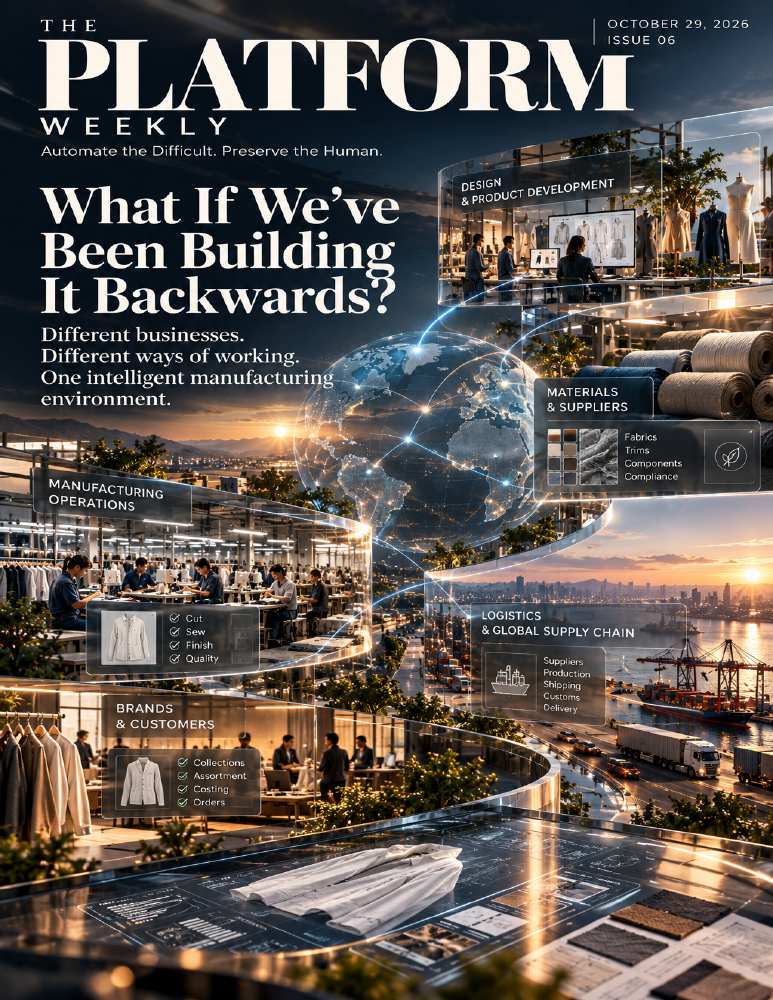
What If We’ve Been Building It Backwards?
Manufacturing has never operated according to a single set of rules. Every factory develops its own methods, every brand has its own expectations, and every supplier works within a different combination of capabilities, relationships and constraints. Yet much of the software built to support these businesses begins with the assumption that they should all operate in essentially the same way. We standardize the processes, define the workflows and create systems that ask businesses to adapt their operations to the structure of the technology.
Perhaps that is where we've been approaching the problem backwards.
The challenge may not be to build software capable of managing every conceivable manufacturing activity, but to create an intelligent operating environment that understands how different businesses work, how their decisions affect one another, and how they can participate in a connected manufacturing ecosystem without surrendering what makes each of them different. The distinction may appear subtle, but it raises fundamental questions about how manufacturing technology should be designed, how businesses might collaborate, and where intelligence can make the greatest difference.
A closer examination of the customization architecture being developed within The Platform has brought those questions into sharper focus this week. What initially appeared to be another layer of functionality may turn out to be something considerably more important: a foundation that allows the system to adapt to manufacturing, rather than requiring manufacturing to adapt to the system.
The Intelligence of Difference
Standardization has always played an important role in manufacturing. Common measurements, quality standards, production methods and operating procedures allow businesses to coordinate work, maintain consistency and deliver products at scale. Without a degree of standardization, the complexity of modern manufacturing would be difficult to manage, particularly when products pass through multiple organizations before reaching the customer.
But standardization and uniformity are not the same thing. A factory in Mexico may manufacture a garment differently from a factory in China, even when both are working from the same technical specifications. One may have internal washing facilities while the other relies on an external specialist. Their material suppliers, production capacities, lead times and quality procedures may differ, yet both can produce an approved product that satisfies the same customer requirements. Those differences are not necessarily inefficiencies to be eliminated. They may represent years of accumulated knowledge, local capabilities and practical experience.
The difficulty arises when software treats those differences as exceptions rather than as an ordinary part of manufacturing. A system designed around one preferred sequence of activities can struggle when another factory follows a different route, or when a brand introduces requirements that do not fit the established procedure. Over time, additional settings and special cases are introduced until the application becomes increasingly complicated, often without becoming genuinely more adaptable.
This is where Kevin's recent work has introduced an interesting possibility. His customization architecture allows organizations to define their own Products, Components and Processes, including the requirements, relationships and rules that govern how they operate. More importantly, these definitions can influence actual business activity rather than remaining isolated in an administrative menu. A Product can be associated with permitted materials and operating procedures, a Process can respond to defined conditions, and an organization can preserve approved versions of its configurations as its business evolves.
The significance lies less in the individual capabilities than in the relationship between them. If a business can define how it operates, and those definitions can guide the work that follows, the application begins to behave differently. Instead of asking the organization to select from a collection of predetermined procedures, the system can begin to understand the organization's own operating model.
That introduces a different kind of intelligence, one concerned not simply with processing information, but with understanding the circumstances in which that information becomes meaningful.
One Platform, Many Ways of Working
The ambition behind The Platform has always been larger than connecting a collection of manufacturing applications. Products, materials, samples, orders, factories, suppliers and logistics are not independent activities that happen to exchange information. They are parts of a continuous operating environment in which decisions made in one place can affect work taking place somewhere else, sometimes weeks or months later. Building that environment requires a common understanding of the relationships between businesses, but it does not require every business to operate identically. A brand should be able to establish its development requirements, a factory should be able to define how it manages production, and a mill should be able to organize its material processes according to its own capabilities. When those organizations participate in the same manufacturing relationship, the system should understand where their activities connect without forcing them to abandon the procedures that make their operations effective.
The architectural work reviewed this week suggests one way of approaching that challenge. Organizations could maintain their own governed configurations while relying on a shared foundation for Products, Components, Processes, relationships, transactions and evidence. Approved definitions would guide how work is created and performed, while the underlying operating model would preserve the information needed to coordinate activities across organizational boundaries. Reusable configurations could also help businesses establish appropriate procedures without requiring every customer to begin with an entirely empty system.
There are important limits to this idea. Allowing organizations to configure their operations cannot mean allowing them to redefine fundamental business relationships so freely that information loses its meaning when it moves between companies. A material must remain identifiable as the same material, an approval must retain its history, and a commercial commitment must remain traceable to the parties responsible for it. The balance between a dependable common foundation and adaptable business behavior is therefore becoming one of the most important architectural questions we need to resolve.
What makes this week's discovery particularly encouraging is that it has emerged from working development rather than from an abstract discussion about future possibilities. Kevin has built meaningful connections between configurable definitions and operating records, including the ability to generate work associated with purchasing, Products and their Components. The implementation is not yet a universal manufacturing engine, and there are still gaps around alternative production configurations and changes to Processes already underway. Nevertheless, it provides something tangible against which the larger operating vision can be examined and refined.
This is also changing the relationship between the two development efforts. The practical product is beginning to challenge assumptions within the broader vision, while the broader vision is helping identify what the practical product will need if it is to grow into a genuinely connected manufacturing environment. The conversation is becoming less about which features belong in which version and more about how the underlying model should behave so that future capabilities can develop without repeatedly rebuilding the foundation.
Manufacturing Rarely Moves in a Straight Line
The same shift in thinking is appearing in our work on sample processing and Process Management. Manufacturing is often represented as a series of activities moving neatly from one stage to the next, but the reality is considerably more fluid. Materials may be sourced while a garment is still being developed, packaging may be prepared before final fitting approval, and several technical or commercial decisions may progress independently until a particular dependency brings them together.
A delay in pre-production illustrates the problem. If a sample requires another fitting, the production start date may need to change, and the final delivery commitment may be affected. Yet the approved fabric may already have been ordered, the supplier may have reserved capacity, and other preparations may remain entirely valid. Moving every activity forward simply because one part of the Process has changed would introduce unnecessary disruption, while ignoring the relationships between activities could conceal a genuine delivery problem.
Our recent discussions have therefore concentrated on how work can proceed in parallel, how dependencies should be understood and how changes can be made without disturbing activities that remain unaffected. Kevin's approach to organizing Processes through parallel and sequential relationships has been particularly useful in exploring these questions. It is a reminder that the intelligence of a manufacturing system will depend as much on understanding what does not need to change as on recognizing what does.
There is also a human dimension that conventional workflow diagrams rarely capture. Different people may participate in different stages of the same Process, and their responsibilities may change as the work progresses. A factory team may need access to certain documents during sample development without having unrestricted access to every technical file belonging to the brand. An external supplier may participate in a particular activity without becoming part of the customer's organization. The system must understand these relationships as part of the work itself, preserving the independence of each business while allowing the appropriate people to collaborate. These details may seem far removed from the larger vision of Intelligent Manufacturing, but they are precisely where that vision must become practical. Intelligence cannot coordinate work reliably unless the system understands which activities depend on one another, who has the authority to act, and which information is relevant to a particular decision. A truly connected operating environment must be capable of accommodating the irregularities of manufacturing without turning every irregularity into a software problem.
The Journey of a Piece of Fabric
Another development this week has brought a longstanding commercial idea into closer alignment with the operating model we are building. It begins with something remarkably ordinary in the apparel industry: a sample card.
A brand discovers a fabric and requests a card to examine its appearance, texture and characteristics. If the material is suitable, the next step may be a request for sample yardage, often shipped directly to a factory developing the garment. The factory produces a sample, the brand evaluates the result, and further adjustments or approvals may follow before the Product is ready for production. Eventually, a decision that began with a small piece of fabric can lead to a bulk material order worth many thousands of dollars.
Each stage is familiar, but the relationship between them is often fragmented. Material discovery may happen through one service, sampling through another, product development through a collection of documents and conversations, and bulk purchasing through a separate commercial system. By the time production begins, the connection between the original material discovery and the resulting purchase may be difficult to establish, even though one activity led directly to the other.
The opportunity is to preserve that relationship throughout the journey. If The Platform understands the material, the brand evaluating it, the factory developing the sample and the mill supplying the fabric, it can potentially follow the progression from initial interest to production. The same operating environment that coordinates sampling and approvals could also understand the commercial relationship created along the way.
This opens a possibility that extends beyond conventional software subscriptions. Where the Platform helps establish and facilitate a material sourcing relationship, it may be possible to participate financially when that relationship generates qualifying sample or bulk purchases. The concept draws on earlier work developing a material sourcing strategy, but its significance here is how naturally it connects to the sample processing, organizational relationships and purchasing activities already being considered within The Platform.
There is a considerable difference between recognizing this opportunity and having a functioning commercial model. The arrangements between brands, factories and mills would need to be established, the originating sourcing relationship would need to be preserved, and the terms under which commissions are earned would need to be agreed. Payment infrastructure may eventually play a role, but processing a transaction is not the same as creating the commercial value that justifies participation in it.
The more interesting possibility is that manufacturing software could become part of the economic activity it helps coordinate. A connected operating environment would not simply record that a material was purchased; it could understand how that purchase emerged from product development and which relationships contributed to it. If the model proves commercially viable, it could create another dimension of revenue while reinforcing the value of keeping manufacturing activities connected.
It also changes how we should think about sample processing. A sample is not necessarily an isolated event that ends when a garment is approved or rejected. It can be an early stage in a relationship that continues through sourcing, production and future orders. Preserving that continuity may prove valuable in ways that are not immediately apparent when the first sample card is requested.
Building the Future Without Waiting for It
Questions about the future of manufacturing inevitably lead to more immediate questions about how that future will be financed. The Platform's larger ambition requires substantial development, industry participation and commercial validation, but there is an important distinction between the capital required to establish the next stage and the investment needed to scale the business over time.
This week, the team began exploring a more deliberate approach to those requirements. Rather than relying entirely on a larger seed investment of approximately $3 million to $4 million, we are considering a smaller initial funding round while continuing conversations around the larger opportunity. The early capital would be intended to establish the necessary legal and intellectual property foundations, provide concentrated development resources and create sufficient runway to bring the product into practical customer environments. The larger raise would continue to develop alongside that work, supported by stronger evidence of what the product can do and how customers respond to it. There is a meaningful difference between presenting an ambitious vision and demonstrating an operating product that has begun solving real problems for real businesses. Both matter, but they serve different purposes in an investment conversation. The smaller round could help create the conditions in which the larger opportunity becomes easier to evaluate, rather than requiring the entire vision to be financed before meaningful commercial evidence exists.
The team is also considering the value of industry participants who can contribute more than capital. A strategic investor with manufacturing experience, relationships with factories or mills, and an understanding of the commercial realities of the industry could help challenge assumptions while opening opportunities for practical validation. Early conversations have been encouraging, although the financing amounts, timelines and potential relationships remain under discussion rather than established commitments.
There is a broader principle here that extends beyond fundraising. Transforming an industry does not happen simply because the technology becomes possible, nor because sufficient capital is available to build it. It happens when an idea encounters the realities of the businesses it is intended to serve, and when the people developing it are prepared to adapt their thinking in response. The financing strategy, early customer relationships and architectural decisions are beginning to develop together because each can provide evidence and direction for the others.
The More Intelligent the System, the Quieter the Experience
There is one final connection running through these developments, and it concerns the people who will eventually use The Platform. As the underlying operating model becomes more sophisticated, the temptation is to expose more of that sophistication through additional screens, settings, dashboards and controls. Yet the purpose of intelligence should not be to give people more complexity to manage. It should be to help them understand what matters and make better decisions with less effort.
The team has been exploring a more distinctive visual direction for The Platform, one that moves beyond familiar business software conventions toward an experience in which information and intelligence are presented with greater context. The opportunity is intriguing, but appearance alone will not determine whether the experience succeeds. A beautiful interface that requires people to navigate the same complexity in a different form would not represent the kind of progress we are seeking.
Customization makes this challenge even more important. If every organization can establish its own procedures, responsibilities and operating requirements, the people performing the work should not need to understand the machinery behind those definitions. A production manager needs to know which decisions require attention and what may be affected by a delay. A product developer needs to understand whether a material is approved and why a sample has not progressed. A factory team needs clear responsibilities and access to the information required to complete its work, without being overwhelmed by everything happening elsewhere.
This is where Scout's role as the intelligent operating presence across The Platform becomes particularly meaningful. Rather than creating separate assistants for every manufacturing function, the objective is to develop intelligence that understands the shared operating environment, including the rules governing different organizations and the relationships between their activities. Scout could eventually help explain why a particular Process applies, recognize when requirements conflict and prepare recommendations grounded in the evidence available, while leaving important decisions under human authority.
The ambition is not to remove people from manufacturing decisions, but to remove some of the unnecessary difficulty surrounding those decisions. If the system can understand the complexity of the operating environment, people should be able to concentrate more of their attention on judgment, creativity, relationships and the situations where experience matters most.
A Foundation for What Comes Next
The developments of this week have reinforced an important distinction between building more software and building a different way for manufacturing to operate. Kevin's customization work suggests that the foundation may need to understand how individual businesses define their operations before we continue expanding the functions those businesses use. Our Process Management discussions show why manufacturing cannot always be represented as a predetermined sequence of activities, while the material sourcing opportunity illustrates how relationships established during development may continue to create value long after the first sample has been approved. The financing discussions add a practical dimension to those discoveries, connecting the resources needed for development with the evidence required to build customer and investor confidence. At the same time, the work on the product experience reminds us that sophistication beneath the surface is only useful if it leads to greater clarity for the people working above it. These are not separate ambitions competing for attention, but different aspects of the same question about how an intelligent manufacturing environment should be designed, introduced and sustained.
Much remains to be proven. The customization architecture needs to be reconciled with the broader operating model, the commercial opportunities around sourcing transactions require validation, and the next stage of development must demonstrate that these ideas can work together in real manufacturing circumstances. There is no reason to confuse a promising foundation with a finished building, particularly when the purpose is to support businesses whose operations are as varied and demanding as manufacturing itself.
But perhaps the most useful discovery is that the future of manufacturing technology may depend less on teaching every business to follow the same process and more on creating an environment capable of understanding their differences. The relationships between organizations, materials, products, decisions and commercial activity are already there. What has been missing is a common operating intelligence capable of connecting them without erasing the knowledge and experience that make each business distinct.
That is the direction The Platform continues to explore: a manufacturing environment that can coordinate complexity without imposing unnecessary uniformity, learn from the relationships between activities, and make the difficult parts of manufacturing easier to understand and manage. The technology should become increasingly capable, but the people using it should remain at the center of the decisions that shape their work.
Automate the Difficult. Preserve the Human.
The Platform Weekly explores the ideas, discoveries and practical work behind a unified Intelligent Manufacturing operating model, and what they may mean for the future of manufacturing.