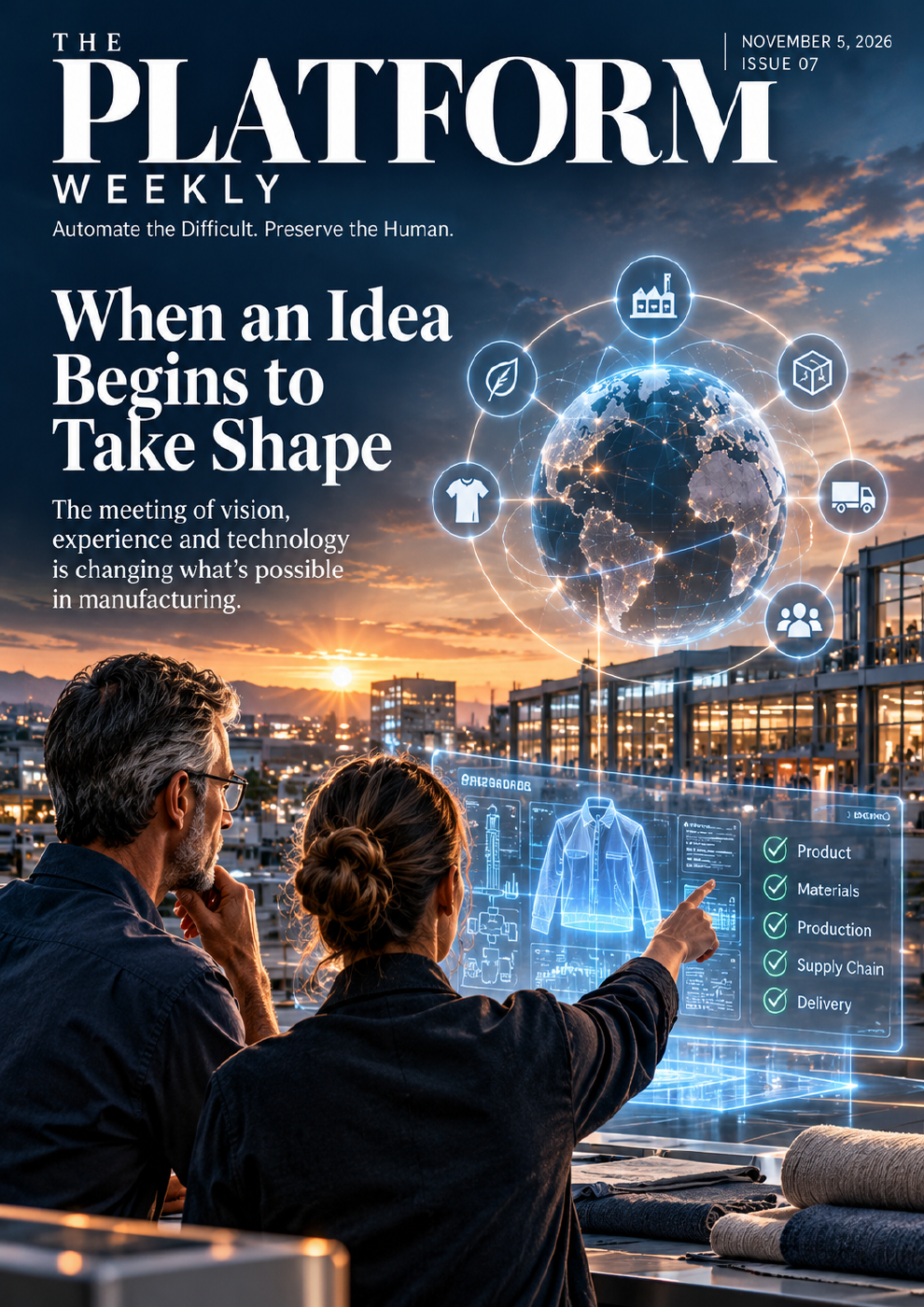
When an Idea Begins to Take Shape
There comes a point when a vision must begin answering to reality. Not because the ambition has changed, but because the people, knowledge and foundations needed to make it possible are finally coming together.
Every meaningful transformation begins with a question about the way things are. Sometimes the question is obvious, prompted by a problem that has become impossible to ignore. More often, it emerges gradually, through years of observing familiar practices and wondering why we continue to accept them as inevitable. The systems become more sophisticated, the technology becomes more capable, yet many of the underlying difficulties remain remarkably unchanged.
Manufacturing is particularly interesting in this respect. It is an industry built on extraordinary human knowledge, technical precision and the ability to coordinate complex activities across organizations and continents. Yet much of that coordination still depends on individuals interpreting information, understanding relationships and resolving the gaps between systems that were never designed to operate as one. We have become remarkably good at managing those gaps, perhaps so good that we rarely question why they exist in the first place.
The ambition behind The Platform grew from a belief that manufacturing deserves something fundamentally different. Not another collection of applications, nor simply a more convenient way to manage familiar processes, but an intelligent operating environment capable of understanding how products, materials, people, organizations and decisions relate to one another. An environment that can accommodate the differences between businesses while helping them work together more naturally, preserving the experience and judgment that make manufacturing possible.
For much of the journey, that ambition has existed alongside the practical work of developing the technology. This week marked an interesting change. The vision and the working product began meeting more directly, with manufacturing experience and technical knowledge being brought together inside the MVP itself. At the same time, the beginnings of a formal corporate structure introduced another kind of foundation, one concerned with how the initiative can become a sustainable business rather than remaining an ambitious development effort.
Neither development is particularly dramatic when viewed in isolation. Together, however, they suggest that The Platform is entering a different stage, one in which the questions are becoming more demanding because the possibilities are becoming more tangible.
The Knowledge We Rarely Write Down
One of the more curious aspects of manufacturing is how much of its intelligence exists outside the systems intended to manage it. An experienced production manager understands that a delayed sample may affect a delivery commitment without necessarily affecting material purchasing. A product developer recognizes when a change to a component requires another approval and when it is simply a correction to information already agreed upon. A sourcing specialist understands the difference between a supplier confirming availability and a business making a commercial commitment.
These distinctions are familiar to the people making such decisions, but they are not always explicitly documented. They are learned through experience, refined through mistakes and passed between colleagues as part of the practical knowledge of running a business. When we attempt to translate that knowledge into software, we often discover that the rules are considerably less straightforward than they first appeared.
A Sales Order, for example, seems like a relatively simple concept. A customer wants to purchase certain products, in specified quantities, at agreed prices and delivery dates. Yet the moment that order begins moving through manufacturing, it becomes connected to material requirements, component availability, purchasing decisions, production capacity and the responsibilities of several different organizations. Some activities must happen in sequence, others can proceed independently, and certain decisions only become necessary when particular conditions arise.
The complexity is not necessarily in the order itself, but in understanding the relationships that give the order meaning.
This has become particularly evident as Kevin and the manufacturing perspective have begun working more directly together within the MVP. Kevin brings an understanding of the technical architecture, its existing capabilities and the decisions that shaped its construction. Manufacturing experience brings a different form of knowledge, grounded in how businesses actually operate, how exceptions arise and why apparently similar activities can have very different consequences.
The discussions are valuable precisely because the two perspectives do not always begin with the same assumptions. A technical model may describe a relationship that appears perfectly logical until it encounters a manufacturing situation that does not fit. Equally, a familiar industry practice may seem self-evident until someone asks how it should be represented, governed and understood by a system.
Neither perspective is inherently more important. One helps establish what can be constructed, while the other challenges whether what is constructed reflects the reality it is intended to serve. The most useful discoveries often emerge when each forces the other to explain something that had previously been taken for granted.
Perhaps this is one of the less obvious challenges of Intelligent Manufacturing. Before technology can begin understanding an industry, we may need to become much better at explaining the knowledge that experienced people have never needed to articulate.
The Difference Between Complexity and Complication
There is a temptation in software development to assume that complexity is something to be eliminated. Simpler interfaces, fewer steps and greater automation are generally desirable, but they can become misleading objectives when the underlying business genuinely requires sophisticated decisions and relationships.
Manufacturing is complex because it involves physical products, material constraints, commercial commitments, human responsibilities and events that do not always unfold as expected. A garment may require several rounds of sampling, a supplier may propose an alternative component, or a factory may need to reorganize production because another customer has changed its requirements. These are not necessarily failures of the manufacturing process. They are part of the environment in which manufacturing operates.
Complication is something different. It occurs when the systems intended to support that environment introduce additional work, unnecessary decisions or artificial restrictions that do not contribute to the outcome. Requiring people to enter information that already exists elsewhere, forcing independent activities into a rigid sequence or making a straightforward commercial decision dependent on several administrative confirmations are examples of complexity being added rather than managed.
The distinction is becoming increasingly important as we examine the MVP. The objective is not to simplify manufacturing until the model no longer represents reality. It is to understand the genuine complexity well enough that the system can absorb more of the difficulty associated with coordinating it.
That requires a different approach to automation. A system should not automatically change every connected activity simply because one event has been delayed. It should understand which relationships are affected, which commitments remain valid and where human judgment is required. Similarly, an intelligent operating environment should not attempt to impose identical procedures on every factory or supplier. It should recognize the common relationships between businesses while respecting the different ways they fulfill their responsibilities.
This is why the recent architectural discussions have become more significant than their individual technical details might suggest. The relationships between Sales Orders, Products, Components, purchasing and manufacturing Processes are not simply connections between records. They represent the underlying logic through which commercial intentions become physical products.
If that logic can be understood and represented reliably, intelligence has something meaningful upon which to operate. Without it, even the most capable artificial intelligence risks becoming another interface that describes information without truly understanding its consequences.
When Experience and Engineering Meet
There is something instructive about the way knowledge develops when different disciplines work closely together. Engineering encourages precision, consistency and explicit definitions. Practical experience often operates through context, judgment and the recognition of patterns that are difficult to reduce to a single rule. Both are essential, but neither naturally speaks the other's language.
The challenge is particularly visible when a working product becomes the place where those perspectives meet. Ideas that appear convincing in a discussion must suddenly account for actual objects, relationships, permissions and decisions. Assumptions become visible because someone has to determine exactly what should happen when a condition changes or an activity begins.
This is not always comfortable work. A question that seems simple may expose a much larger architectural issue, while a capability that took considerable effort to develop may need to be reconsidered because its underlying assumptions do not reflect manufacturing practice. Progress can become difficult to measure by the number of features completed, particularly when the most valuable outcome of a discussion is the recognition that something needs to be approached differently.
Yet there is a strong argument that this is where meaningful product development begins. Building technology around an imagined version of how an industry operates can produce impressive demonstrations, but the real test arrives when the system encounters the knowledge, exceptions and expectations of people who work in that industry every day.
The Platform is beginning to benefit from that encounter. Kevin's work provides a substantial technical foundation, while the broader manufacturing vision helps identify the relationships and capabilities that foundation must eventually support. The objective is not to discard what has been built or to force the entire future vision into the current MVP. It is to allow the two perspectives to inform one another so that immediate development contributes to a more coherent long-term operating model.
There is also an important philosophical distinction between designing software for people and designing it with an understanding of their work. The first can produce applications that perform the functions described in a specification. The second requires a deeper appreciation of why people make particular decisions, what information they rely upon and how their actions affect others.
An intelligent manufacturing environment will ultimately need both. It must have the technical discipline to preserve information and enforce legitimate boundaries, while remaining adaptable enough to support the varied realities of manufacturing. The intelligence should not replace experience, but make that experience more effective by removing unnecessary administrative effort and making the consequences of decisions easier to understand.
That is a considerably more demanding ambition than simply automating a collection of tasks, but it is also where the opportunity becomes more interesting.
The Space Between Businesses
The relationships we are examining inside the MVP also point toward a larger question about how manufacturing operates beyond the boundaries of an individual company.
A brand, factory and textile mill may each maintain accurate information about their own activities, yet the relationship between those activities can remain surprisingly difficult to follow. The brand's Purchase Order becomes the factory's Sales Order. The factory's material requirements may become a mill's Sales Order, while another supplier provides components required for the same finished garment. Each business has its own commercial interests, operating procedures and responsibilities, but they are participating in a common manufacturing journey.
Traditional business software has largely developed around the needs of individual organizations. This has been useful and, in many cases, necessary. Businesses must maintain independent records, protect confidential information and retain authority over their own decisions. The difficulty is that manufacturing does not stop at those organizational boundaries, even when the software does.
Perhaps the future lies not in removing those boundaries, but in making the relationships between them more understandable.
An intelligent manufacturing environment could allow independent businesses to maintain their own operating methods while participating in shared processes where their activities intersect. A factory would not need to surrender its internal production information to a customer simply to communicate progress, and a mill would not need to expose its commercial arrangements with every other buyer to confirm a material commitment. What matters is that the appropriate information can move between participants with its meaning, responsibilities and permissions intact.
This is a different proposition from simply connecting applications through integrations. Exchanging data is useful, but understanding the significance of that data is what makes coordination possible. A delivery date has little meaning without understanding what is being delivered, who is responsible, what dependencies remain and whether the commitment has changed.
The broader vision for The Platform is increasingly concerned with this space between businesses, where so much of manufacturing's coordination effort currently takes place. It is also where a more connected operating model could begin creating value that individual applications cannot easily provide on their own.
The objective is not to make every participant behave identically. It is to allow different participants to operate more intelligently together.
Giving the Vision a Business of Its Own
While the technology is being challenged by the realities of manufacturing, another important development is beginning to take place. The initial work toward establishing the corporate structure for The Platform represents a different kind of transition, one that is less visible than product development but equally necessary if the initiative is to become a lasting business.
An idea can remain flexible for a long time. It can evolve through conversations, experiments, prototypes and the contributions of people who share an interest in what might become possible. That freedom is valuable, particularly when the ambition involves rethinking established industry practices rather than introducing a narrowly defined product.
But there comes a point when a shared ambition requires more formal commitments. The relationships between founders and contributors need to be understood, intellectual property must have a clear home, responsibilities must be established and the structure must be capable of supporting investment, customer agreements and the people required to develop the business.
These are sometimes treated as administrative matters that sit outside the more interesting work of innovation. In reality, they are part of what allows innovation to survive beyond its earliest enthusiasm. A compelling vision can attract interest, but a business requires an organization capable of accepting responsibility for delivering it.
The beginnings of this corporate work are therefore significant, although the structure itself is still taking shape. The immediate objective is not simply to create a legal entity, but to establish a dependable foundation for the people, technology, ownership and commercial relationships that will support The Platform's development.
There is an interesting parallel with the operating model we are building. Manufacturing businesses need clear responsibilities, governed relationships and a common understanding of their commitments if they are to work effectively together. A new technology business faces a similar requirement as it brings together founders, engineers, commercial partners, advisors and investors.
In both cases, the value of structure is not that it removes independence or creativity. It is that it provides enough clarity and trust for different capabilities to contribute toward a common purpose.
This also connects to the financing conversations that have been developing over recent weeks. The possibility of an initial funding round, followed by a larger investment as the product and commercial evidence mature, reflects an attempt to match resources to the actual stages of development. Establishing the corporate and ownership foundations is part of making those conversations credible, just as developing a working product and demonstrating recognizable customer value will be essential to sustaining them.
The business is not yet fully formed, and the path ahead will undoubtedly require adjustments. But the beginning of formal structure signals that the ambition is moving beyond the question of what could be built toward the more demanding question of what must exist to make it sustainable.
Intelligence Should Make Work Feel More Human
There is a recurring concern whenever artificial intelligence enters a discussion about the future of work. If technology becomes capable of understanding increasingly sophisticated activities, what role remains for the people who have spent their careers developing the knowledge required to perform them?
For The Platform, that question is not an afterthought. It is central to the philosophy guiding the initiative.
Manufacturing is not simply a sequence of transactions waiting to be automated. It is a human endeavor involving creativity, craftsmanship, technical judgment, commercial relationships and the ability to respond when circumstances change. A product developer's experience cannot be reduced to a list of approvals, nor can a production manager's judgment be captured entirely through a schedule. Those people understand context that is often missing from the records surrounding their work.
The opportunity for intelligence is to make that context more accessible and useful. If a system can interpret technical documents, preserve the relationships between materials and products, recognize when a decision affects another activity and explain the evidence behind a recommendation, people can spend less time reconstructing information and more time applying their knowledge.
This is the distinction between automating a decision and supporting the person responsible for making it. Some activities may eventually be handled automatically because their requirements are well understood and the consequences are limited. Others will require approval, professional judgment or commercial authority. The intelligence of the system should include knowing the difference.
Scout, the intelligent operating presence envisioned across The Platform, will need to develop within those boundaries. Its value will not come from appearing capable of answering every question, but from understanding the operating environment well enough to identify what matters, explain why it matters and recognize when the appropriate person must remain responsible for the outcome.
There is a certain irony in the possibility that increasingly sophisticated technology could make manufacturing feel less dominated by technology. The more complexity an intelligent operating environment can responsibly manage beneath the surface, the less effort people may need to devote to navigating systems, reconciling information and searching for explanations.
Perhaps the most successful application of artificial intelligence in manufacturing will not be the one that makes people most aware of its intelligence, but the one that allows them to concentrate more naturally on the work they know how to do.
From Possibility to Purpose
The progress of an ambitious idea is rarely as orderly as the plans created to describe it. There are periods when development appears to move quickly, followed by others in which a single question exposes assumptions that need to be reconsidered. Some discoveries lead to new capabilities, while others reveal that a more fundamental understanding is required before the next stage can begin.
The recent work within The Platform is increasingly reflecting that reality. Bringing manufacturing experience and technical architecture together inside the MVP is exposing relationships that need to be clarified, not simply functions that need to be completed. The beginnings of the corporate structure are introducing the commitments required to turn a development initiative into a sustainable business. And the broader vision continues to provide a reason for making those decisions carefully, rather than treating each immediate requirement as an isolated problem.
These developments matter because they are connected by a common purpose. The objective is not to build the largest possible collection of manufacturing features, nor to introduce artificial intelligence wherever an opportunity for automation can be found. It is to create an operating environment that understands the relationships through which manufacturing actually happens, reduces unnecessary difficulty and allows independent businesses and experienced people to work together more effectively.
There is still a considerable distance between that ambition and a fully realized Intelligent Manufacturing platform. The MVP must continue to be challenged by real manufacturing requirements, the underlying architecture must support relationships that extend beyond individual workflows, and the emerging business must establish the commercial foundations needed to sustain development. None of those outcomes should be assumed simply because the direction is becoming clearer.
But something important happens when a vision begins encountering the disciplines required to make it real. Questions become more precise, assumptions become easier to challenge and the people involved begin developing a shared understanding of what they are actually trying to accomplish. The vision does not necessarily become smaller. It becomes more grounded in the realities that will determine whether it succeeds.
Perhaps that is what it means for an idea to begin taking shape. Not that the uncertainty has disappeared, or that every important decision has been made, but that the ambition is gradually acquiring the knowledge, relationships and structure needed to move beyond possibility.
For The Platform, the mission remains to help transform how manufacturing operates, coordinates, learns and makes decisions. The vision is of an intelligent, connected manufacturing environment in which businesses retain their independence, information retains its meaning and people are supported rather than overwhelmed by the systems surrounding their work.
The work now is to give that vision a foundation strong enough to support it, while remaining open to everything that practical experience still has to teach us.
Automate the Difficult. Preserve the Human.
The Platform Weekly explores the ideas, discoveries and practical work behind a unified Intelligent Manufacturing operating model, and what they may mean for the future of manufacturing.